
Please Note: This article is written for users of the following Microsoft Word versions: 97, 2000, 2002, and 2003. If you are using a later version (Word 2007 or later), this tip may not work for you. For a version of this tip written specifically for later versions of Word, click here: Horizontally Viewing All Your Text.
Normally, Word displays text on the screen as it will appear on a hard-copy printout. This feature is often referred to as WYSIWYG (pronounced whizzy-wig), which means "what you see is what you get." There may be times, however, when viewing documents this way can be bothersome. For instance, if you are working on a very wide document, or if you are using a computer set to a low video resolution. In these instances, the only way to see all your text horizontally is to scroll left and right—which can get to be very tedious.
If you get tired of scrolling left and right, you can try the following:
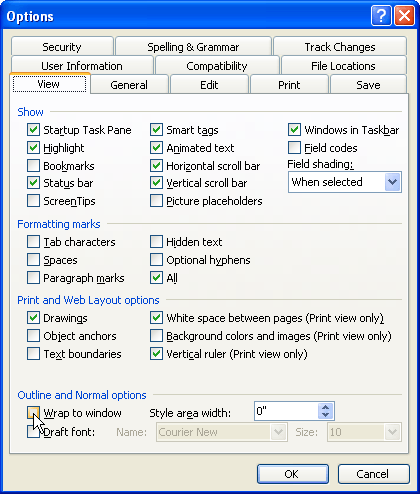
Figure 1. The View tab of the Options dialog box.
This check box essentially turns off most of the WYSIWYG features of Word. Instead, none of your document lines will extend beyond the right-most edge of your screen. When you later want to see what your document will look like on a printout, simply repeat the above steps to set the check box.
WordTips is your source for cost-effective Microsoft Word training. (Microsoft Word is the most popular word processing software in the world.) This tip (49) applies to Microsoft Word 97, 2000, 2002, and 2003. You can find a version of this tip for the ribbon interface of Word (Word 2007 and later) here: Horizontally Viewing All Your Text.
Learning Made Easy! Quickly teach yourself how to format, publish, and share your content using Word 2021 or Microsoft 365. With Step by Step, you set the pace, building and practicing the skills you need, just when you need them! Check out Microsoft Word Step by Step today!
Teaching children to write the alphabet can be rewarding. One common way to teach is to create worksheets that show ...
Discover MoreYou can use a built-in Word feature (RAND) to create random text, but such text may not be to your liking. This tip ...
Discover MoreEver wonder where Word stores all its settings and configuration information? There are only three places where this ...
Discover MoreFREE SERVICE: Get tips like this every week in WordTips, a free productivity newsletter. Enter your address and click "Subscribe."
There are currently no comments for this tip. (Be the first to leave your comment—just use the simple form above!)
Got a version of Word that uses the menu interface (Word 97, Word 2000, Word 2002, or Word 2003)? This site is for you! If you use a later version of Word, visit our WordTips site focusing on the ribbon interface.
Visit the WordTips channel on YouTube

FREE SERVICE: Get tips like this every week in WordTips, a free productivity newsletter. Enter your address and click "Subscribe."
Copyright © 2026 Sharon Parq Associates, Inc.
 Please Note:
This article is written for users of the following Microsoft Word versions: 97, 2000, 2002, and 2003. If you are using a later version (Word 2007 or later), this tip may not work for you. For a version of this tip written specifically for later versions of Word, click here:
Please Note:
This article is written for users of the following Microsoft Word versions: 97, 2000, 2002, and 2003. If you are using a later version (Word 2007 or later), this tip may not work for you. For a version of this tip written specifically for later versions of Word, click here: 
Comments