
Word allows you to create forms into which users can enter data. Exactly how you create forms has been covered in other issues of WordTips. When users are done filling in the form, they typically save the form as a regular Word document.
If you want to later use the form data in a database, you may find this tip helpful. Follow these steps:
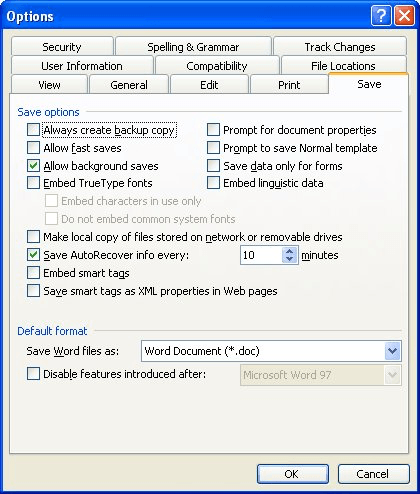
Figure 1. The Save tab of the Options dialog box.
Now, when you go to save the document, Word presents you with the Save As dialog box, and the TXT file format is selected. Once you supply a file name and click on OK, Word extracts the form data the user typed in the document and saves it, in a comma-delimited format, in the TXT file. You can then use that TXT file to import the form values to a database program.
WordTips is your source for cost-effective Microsoft Word training. (Microsoft Word is the most popular word processing software in the world.) This tip (600) applies to Microsoft Word 97, 2000, 2002, and 2003.
Discover the Power of Microsoft Office This beginner-friendly guide reveals the expert tips and strategies you need to skyrocket your productivity and use Office 365 like a pro. Mastering software like Word, Excel, and PowerPoint is essential to be more efficient and advance your career. Simple lessons guide you through every step, providing the knowledge you need to get started. Check out Microsoft Office 365 For Beginners today!
Ding! You've got mail. That mail has a Word document attached to it. Before you rush off and open that document, take a ...
Discover MoreNeed to store some information in a plain text file? It's easy to do when you use a macro.
Discover MoreWant to rename a document that is already on your hard drive? You can, of course, do it in Windows, but you can also do ...
Discover MoreFREE SERVICE: Get tips like this every week in WordTips, a free productivity newsletter. Enter your address and click "Subscribe."
There are currently no comments for this tip. (Be the first to leave your comment—just use the simple form above!)
Got a version of Word that uses the menu interface (Word 97, Word 2000, Word 2002, or Word 2003)? This site is for you! If you use a later version of Word, visit our WordTips site focusing on the ribbon interface.
Visit the WordTips channel on YouTube

FREE SERVICE: Get tips like this every week in WordTips, a free productivity newsletter. Enter your address and click "Subscribe."
Copyright © 2026 Sharon Parq Associates, Inc.

Comments