
Please Note: This article is written for users of the following Microsoft Word versions: 97, 2000, 2002, and 2003. If you are using a later version (Word 2007 or later), this tip may not work for you. For a version of this tip written specifically for later versions of Word, click here: Tool to View Field Codes.

Tools to View Field Codes

Written by Allen Wyatt (last updated July 7, 2018)
This tip applies to Word 97, 2000, 2002, and 2003


You know you can use the Field Codes check box on the View tab of the Options dialog box to control whether or not field codes are displayed in your document. You may even know that you can use Alt+F9 to switch between field codes and their results. However, what if you are mouse-bound, and want to accomplish the same task quickly without resorting to the keyboard?

You can add a tool to any toolbar you want that will toggle between field codes and field results. To add such a tool to your toolbar, follow these steps:
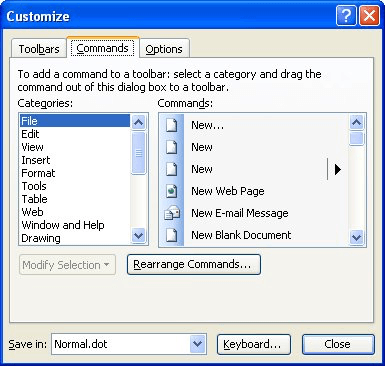
  1. Choose Customize from the Tools menu. This displays the Customize dialog box.
  2. Make sure the Commands tab is selected. (See Figure 1.)
  3. Figure 1. The Commands tab of the Customize dialog box.

  4. In the list of Categories, select View.
  5. Select View Field Codes from the list of commands in the dialog box.
  6. Use the mouse to drag the command (or button) from the dialog box to its new location on your toolbar. When you release the mouse button, a new icon appears on the toolbar.
  7. Click on Close to dismiss the Customize dialog box.

Now, when you want to see your field coding, click on the new icon. Click again, and the results of the field codes are instead displayed.

WordTips is your source for cost-effective Microsoft Word training. (Microsoft Word is the most popular word processing software in the world.) This tip (542) applies to Microsoft Word 97, 2000, 2002, and 2003. You can find a version of this tip for the ribbon interface of Word (Word 2007 and later) here: Tool to View Field Codes.
Author Bio

Allen Wyatt

With more than 50 non-fiction books and numerous magazine articles to his credit, Allen Wyatt is an internationally recognized author. He is president of Sharon Parq Associates, a computer and publishing services company. ...

MORE FROM ALLEN

Copying Worksheet Code Automatically

When creating a workbook to be used by others, you may want any worksheets they add to the workbook to contain some ...

Discover More

Printing Workbook Properties

Want to create a printed record of the properties associated with a workbook? There is no easy way to do it in Excel. ...

Discover More

Quickly Dumping Array Contents

Variable arrays are used quite often in macros. If you use an array once in your macro and then need to reuse it for ...

Discover More

The First and Last Word on Word! Bestselling For Dummies author Dan Gookin puts his usual fun and friendly candor back to work to show you how to navigate Word 2019. Spend more time working and less time trying to figure it all out! Check out Word 2019 For Dummies today!

More WordTips (menu)

Understanding Default DATE Field Formatting

The DATE field is one of the most commonly used fields for placing dynamic information in your document. It is helpful to ...

Discover More

Special Characters in Fields

If you try to add a quote mark or a backslash as part of a field parameter or switch, you may be surprised at what you ...

Discover More

Sticking with the Dashes

By default, dashes don't "stick" to the text that follows them. Here's one way around this normal formatting convention.

Discover More
Subscribe

FREE SERVICE: Get tips like this every week in WordTips, a free productivity newsletter. Enter your address and click "Subscribe."

View most recent newsletter.

Comments

If you would like to add an image to your comment (not an avatar, but an image to help in making the point of your comment), include the characters [{fig}] (all 7 characters, in the sequence shown) in your comment text. You’ll be prompted to upload your image when you submit the comment. Maximum image size is 6Mpixels. Images larger than 600px wide or 1000px tall will be reduced. Up to three images may be included in a comment. All images are subject to review. Commenting privileges may be curtailed if inappropriate images are posted.

What is nine more than 1?

There are currently no comments for this tip. (Be the first to leave your comment—just use the simple form above!)


This Site

Got a version of Word that uses the menu interface (Word 97, Word 2000, Word 2002, or Word 2003)? This site is for you! If you use a later version of Word, visit our WordTips site focusing on the ribbon interface.

Videos
Subscribe

FREE SERVICE: Get tips like this every week in WordTips, a free productivity newsletter. Enter your address and click "Subscribe."

(Your e-mail address is not shared with anyone, ever.)

View the most recent newsletter.